Friday, 25 September 2015

Week #25: Tithe

Simplicity is both an internal and external discipline.  It speaks to the very way we perceive the matters of faith and life and has dramatic effectIn on the manner in which we live in this world. There is perhaps no deeper realm to this, or perhaps none more uncomfortable, that the manner in which we understand, use, and relate to money.

Money is deeply ingrained in the very manner in which we live; there is simply no way around it.  We use money, we spend money, we save money.   Yet too often we fail to see our relation to money in any sort of spiritual context.  It is simply that which is used as we go through the functions of our every day lives.  Yet peel back the layers and we find that too often the money we have, or long to have, exerts a dominating force upon us.  It controls us.  It drives our action, establishes our focus, and calls our attention. We dream of 'striking it rich', 'hitting it big', or moving from 'rags-to-riches.'  These lies communicate to us that accumulation of money is that which solves all our problems.  We dream about what we will do when we win the lottery thinking that a massive influx of cash will set our life in order.  Yet too often those who win the lottery find quickly find themselves in financial, moral, emotional, and spiritual bankruptcy.

Money promises freedom and happiness yet delivers slavery and depression. It keeps us in anxiety and fear.  It tells us to be fearful of never having enough, despite the fact that too often that which it calls us to is far from necessary.  It keeps us always focused on the riches we do not have, rather than highlighting the riches we do.  Jesus knew that money too easily becomes a rival God demanding servitude.  "You cannot serve both God and money (mammon)."  Jesus knew that the money is able to exert an intoxicating pull over us. Like a rival deity it demands an emotional attachment. We become identified with how much we have and find ourselves unable to part with the smallest of units.  Is it any wonder that our modern world, so full of abundance, has produced such a soul-crippling problem as hoarding?

This is why the discipline of tithing can be so powerful.  Tithing dethrones the rival power.  It frees from the emotional enslavement that money too often holds over our lives.  In tithing we reclaim our proper place.  This is because tithing, ultimately, is not just actually about money.  Tithing is about worship.  It is about divine allegiance.  In tithing we strip money of the sacredness that this world wrongly gives to it, and again submit ourselves in humble faith to the Lord of heaven and earth. In this we enter into the joy and freedom found in a posture of dependance.  Ours is not to strive and fret - ours is to humbly receive and give thanks.  Consider the lilies and the birds, Jesus says.

Through tithing we truly uncover the beauty and goodness of all that surrounds us.  The goodness seen in that which we own occurs truly as  we see these things as expressions of God's care and providence for us.  This frees us from the burden of having to protect or hoard that which we own.  For if the goodness of money is found, not in the ownership of it, but in its kingdom use, then we are able to uncover the blessedness of giving.  "We would be hard pressed," writes Richard Foster, "to find a teaching on money [in the Bible] that does not somehow mention giving."  (From 'The Challenge of the Disciplined Life').

There are many ways that we can enter into the discipline of tithing.  While it does not have to be the typical 10%, we must resist the attempt to minimize its force.  To do this is to value our ownership of money over our life with God.  If tithing is seen only as an obligation, or worse yet - a bill, then we will never see it as an act of  thanksgiving.  The tithe should be significant enough that we notice the gift for it is in noticing that we express our thanks to God for all of God's blessings in life.  It is an act of praise and thanksgiving.  We do not retain a sense of deserve or ownership of our money - we release it all into the hands of God and in doing so render our confidence and trust.

It should also be mentioned that we are also able tithe our time and/or service. Tithing does not have to be a gift of money.  It can also be a gift of our time and our effort.  Too often our life with God is relegated to 90 minutes on Sunday mornings while the rest of our lives are spent living unto ourselves.  When we tithe our time or effort, we recognize the possible incongruity between our that which we say we believe, and how we actually live it out.  What would it be like to increase my time with God each day?  Can we spend more time in prayer, in worship, in study? Are my faithful expressions done out of duty or out of an internal desire to be with our Lord in intimate relationship?

The mathematics of tithing, whether it is in time/service or money, is not about 10% here and 10% there.  Tithing is  about our life with God; about our focus, our worship.  And to that end it should always equal 100%.

Wednesday, 16 September 2015

Week # 24: Do not take part in Gossip.

'Sticks and stones may break our bones but names will never hurt us.'  It sounds good doesn't it? It suggests that as long as we feed continually on this mantra then the taunts and insults of haters will simply roll off of our backs.  The rhyme makes it sound as if our words lack the the power to inflict deep and lasting wounds.  It promises to keep us inwardly strong and stalwart.  Too bad it's a lie.  Names hurt.  Words scar.  We have seen this time and time again.

Long before this rhyme was thought up, James wrote 'The tongue is placed among our members as a world of iniquity; it stains the whole body, sets on fire the cycle of nature, and is itself set on fire by hell.'  (James 3:6) It is a truth testified to far too often. Gossip destroys people and communities.

The root of gossip is selfish pride.  It is selfishness which says that we need to be the center of information, and it is arrogant pride that reduces someone's identity to the sole product of the stories we hear and tell.  The sly whispers in the parking lot, the casual utterances of 'well that's not what I heard', the willful re-telling of events in someone else's life, all play on the idolatrous notion that we are more important than others.  We speak about matters which we have no right to speak to.  We tell stories that are not ours to tell.

Sometimes this seems innocent enough.  We tell of another's medical diagnosis under the rhetoric of 'people should know.'  Or, as often is the case in the church, we aggressively plumb for deeply personal information, often referencing why it is important that we know such information. 'Why are they on the prayer list?' we ask.  "Have you heard about so and so?" "I need to know how to pray for them.'  In this we reduce the other to the sole product of the stories we hear or the tales we tell.  We fundamentally deny their personhood through the insistence that we know what is best for them. Shirley Hughson writes "One of the most frequent and hurtful occasions of pride is the readiness with which most of us give our opinion or instruct others, on any subject that might be introduced into conversation.'  It is 'enslavement to talking' writes Johnson.

It used to be that gossip was reserved for shadowed conversations occurring in the background.  Social media has changed all that.  In a world that is so laden with text - from Internet forums to text messages to social media posts - the manner in which we speak to each other is of utmost importance.  Just like face-to-face gossip, we need to see the words we write as coming from the deep centres of our being.  Our words, whether typed on a keyboard or spoken in private, bare our souls and they declare what is in our hearts.  When our gossip or bullying destroys the personhood of another, we should feel deeply ashamed.

The tongue is a restless evil precisely because through it we are able to hurt someone more deeply than sticks and stones could ever do. "With the tongue we bless The Lord and Father, and with it we curse those who are made in the likeness of God" (vs 9). Our words cut to the heart and are able to destroy the soul.  How can this not be seen as hellish behaviour?

Here is an interesting thought experiment: What would happen in the world if we gave up gossip?  What effect would there be if we embraced the refusal to speak out of turn, to whisper behind another's back, to keep our disparaging remarks to ourselves?  How would the world be different?

For those of us in the church, this shouldn't really be a thought experiment;  it should be the very manner in which we live out our faith lives.  The matter of how we speak to each other is not merely a matter of politeness or social nicety.  It goes to the heart of faith.  Our holiness, or lack thereof, is displayed for the world in how we speak to each other.    James concludes his discussion on the tongue by stating that 'out of the same mouth come blessing and cursing.  My brothers and sisters, this ought not to be so.' (vs.10)

What if we simply decided not to tell other people's stories - good or bad.  What if the phrases  'guess what I heard' or 'Did you hear about ..' were viewed to be as offensive as the worst four-lettered swear.  Doing so would release us from the enslavement to talking, and the prideful wielding of others' stories. It would focus us away from self interest, and the building up of our own image, and ground us in the call to bless and edify others.

With celebrity expose's around every corner, we need to be reminded that it is not our job to have all the information in people's lives - or to tell events that are not ours to tell.   Refraining from gossip-filled conversations is a simple act by which we free ourselves from the 'information is power' way of thinking.  No longer are we concerned with the management of our image - which too often is seen as related to another.  In refraining from gossip we strive to be content with not knowing the ins and outs, the latest scoop, or the rest of the story, as we release such matters into the gracious keeping of God.

May the words of our mouths, and the meditation of our hearts, be acceptable to God, our rock and our redeemer.

Friday, 4 September 2015

Week #23: Make your confession

It is said that confession is good or the soul, but how many of us actually take this to heart?  Unless we come from a religious tradition that makes confession a liturgical necessity this discipline too often get's pushed to the side.  Even then, confession can become a dry and lifeless liturgical hoop to go through.  We make our confession without any real desire for spiritual or moral change.  Similar is the case of corporate confession.  The moment when congregation says together 'we confess our sins to Almighty God . .' simply becomes nothing more than a prayer we rattle off giving no thoughts to matters such as repentance or the amendment of life.  In each case true confession is fundamentally rejected.

From where did we get the curious notion that the call to confession was somehow contrary to the love and grace of God?  Why is it that we see confession as an exercise akin to guilt-mongering instead of one that ushers in spiritual freedom and closeness with Christ?

When we refuse to confess our sins to God, we choose to keep parts of ourselves hidden.  We mask the state of our heart and souls, and we thus we live in a self-deceiving lie. It is not that we are hiding these things from God, but we fail to engage ourselves in true and humble honesty. We put up a front.  Instead of engaging those deep places of our soul, the longings, the hurts, the wounds, the sins, we plaster them over with a schtick of 'I'm Ok, You're Ok.'  All the while, internally, we are crying for a depth of spiritual freedom that somehow, amid our best efforts, remains forever elusive.

How can we find the freedom that we so desperately crave if we do not seek in the fullness of who we are?

Confession is good for the soul precisely because it frees it from the toxic self-deception and festering negative forces that can too often eat away at us.  Just listen to David: "For when I kept silent my bones wasted away through my groaning all the day long.  For day and night your hand was heavy upon me; my strength was dried up as by the heat of summer."  (Psalm 32:3-4)  Living self-deception exhausts us.  It drains our spiritual livelihood. Slowly, the reality of our Lord's love and mercy becomes replaced by things such as fear, guilt, and shame.  Our spirits are left feeling wasted and dried up.

Confession can be hard and challenging, but ultimately God leads us into so that we can be free from the sins, hurts, and wrongs that shackle our spiritual lives.  This is why God's hand is sometimes 'heavy upon us', not because God delights in seeing us writhe in guilt-ridden agony, but because God desperately wants us to the experience the full force of liberating love.  After uncovering how the silence about his true spiritual condition is inwardly destructive, David continues: 'Then I acknowledged my sin to you, and did not cover my iniquity;  I said "I will confess my transgressions to The Lord," and you forgave the iniquity of my sin' (vs. 5).

Confession is important for a life of simplicity because it causes us to look at our spiritual life as it truly is.  After all, how can we live a life of single-hearted focus on God if we are not honest about our struggles or needs.  We cannot have a singleness of heart and hold onto spiritual duplicity.   If we deny the struggles of faith, or the frailty of our lived-out relationship with God, we only deceive ourselves and the truth - the truth of God's full redemption, the truth of who we are before our Lord - is not in us.  Confession does not make God love us, God loves us in every instance and moment, but confession does produce an inner vulnerability that opens us to divine love unhindered by all that we try to hide.

There are several ways that we can incorporate confession into our spiritual lives.  Confession is really is not that hard.  All it takes is a humble honesty about ourselves.  You may choose to obtain a 'confessor,' someone whom you will be honest with, and whom you will accept their words of absolution as divine truth.  This person doesn't have to be a pastor or priest, but it is helpful if they are.  Confessing to someone can be difficult and scary, and you will want to pray about the person you choose as a confessor.  Such a relationship must be mutually established and agreed upon. This is why a priest or pastor is a good option, for they will already be accustomed to things such as accountability, confidentiality, and prayerfulness.  

Of course, you don't have to confess to another human individual.  We can confess directly to our Lord.  In many ways this is a 'safer option',  but therein lies the challenge.  We must work hard at full disclosure.  A good suggestion would be to write your confession down on paper.  There is something deeply moving about writing down 'I judged x' or 'I yelled at y'.  Somehow, seeing it written down helps us understand the reality of these things in our lives. Once you have written down all that you choose to confess, sit with that reality. Don't rush past this too quickly.  Experience the discomfort, the sorrow, the desire for forgiveness.  Pray a simple, uncomplicated prayer, one that asks God forgive you of these matters.  After a certain amount of time you may experience these sins slowly melt away.  In manners which are unique to you, you will feel the truth of forgiveness.  When this happens, it is good to write 'Forgiven' over everything you wrote.  Again, there is something about seeing the word 'Forgiven' stamped over your particular sins that helps us understand the reality of the freedom and redemption that you have been lead into.

Confession, ultimately, is not about our sins.  It is about the love of God and God's desire to forgive.  In confession, this is what we are left with - and this is the experience that surrounds this discipline.

Monday, 24 August 2015

Week #22: Discover Church as Sacred Space

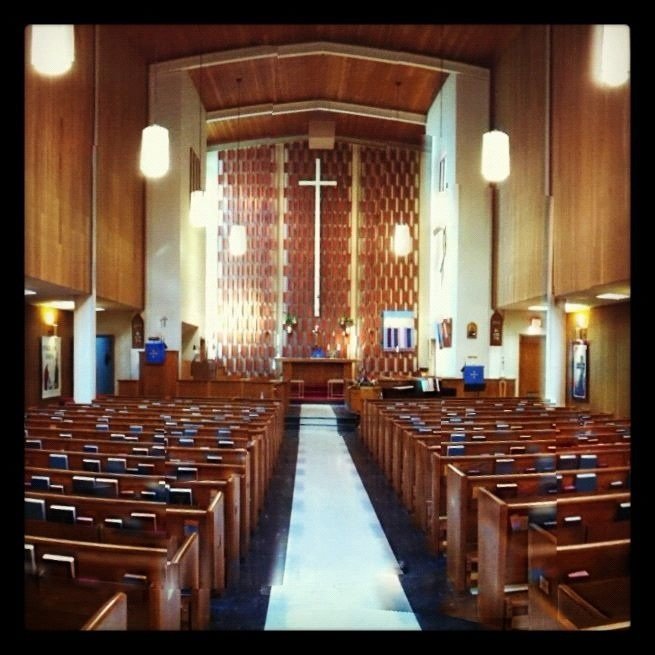
imageWhat is your understanding of sacred space? Is it merely a spot conducive to relaxation and rest? Is the sacredness of a space dependent upon how much you enjoy your time there? Is there any difference between the sacredness found in cabin get-a-ways and golf-course greens, and that which is to fundamentally define the church?
Our life with God has become so individualized in contemporary society that I wonder if we downplay the understanding that church is the house of God. Truth be told, when talking about sacred space, does ‘church’ even enter our minds? A common quip today is “I don’t need to go to the church to be with God, I can worship God equally on the golf course, or the ski hill, or the summer cottage, or the coffee shop.” True. God is everywhere. We see this reality testified to again and again in scripture. Yet scripture also maintains that there is something special about the sacred space of the temple – or later on – the gathered collection of worshipers known as ‘the church’. The temple was seen as God’s house, the localized tent in which God’s presence would reside in magnificent glory. Even though God was everywhere, the psalmists would cry out ‘I was glad when they said, let us go to the house of The Lord’ (Psalm 122:1) or “How lovely is your dwelling place, O Lord Almighty’ (Psalm 84:1). Of course, the internal longing to be in the courts of The Lord was not based merely on the beauty of the building, or the majesty of its adornments. For those in the Old Testament and the New, to be in the temple was to be in the very presence of God, and to be surrounded by the wonderment of God’s divine activity.  God’s presence, localized in the context of the temple,  something incredibly special and unique, not to be duplicated or copied in other places within the world.
Is that the way we see the church today? Do we understand the church as sacred space, a space defined by God’s presence and activity? As we travel along the road and approach our buildings, do we believe, anticipate, andexpect that we will be in the presence of God?
Sadly, it is far too easy to see the church only in human terms. Church becomes nothing more than the place we come to sing religious songs, to hear scripture read, to touch base with friends. (Personally speaking, it is far too easy for me to see church as simply the place that I work. It is the building that houses my office). But if we understand the nature of the church only through the lens of what we do, we completely miss out on its blessed sacredness. If this is the case, then the adage is entirely correct: it does not matter if one goes to church for these religious actions can be done with the same effectiveness wherever one chooses to be.  In this way, sacredness simply becomes a function of where we are, not where God is. This obviously has disastrous effects on the how we view the church, and the God we worship. As Graham Standish writes in his book ‘Becoming a Blessed church’, God merely becomes ‘a theological principle we speculate about rather than a spiritual presence we encounter and experience.’
What is the church if it is not a place where we meet the very one who created, redeemed, and sustains us. Just as Moses was instructed before the burning bush to remove his sandals, as the place he stood was holy ground, so too, we should be overwhelmed by the presence of God active in and throughout the life of our churches.  We should enter through the doors of the church with our hearts leaping with anticipation over what God will do in our midst.
Why did the psalmists write so lovingly of the temple? Why did the disciples spend their time in the temple immediately following the resurrection? Why did Paul, Barnabas, Philip, and others, labour so hard to set up locations in which people would gather together in worship, if these places were not to be understood as spaces where we are invited to encounter the miraculous and powerful presence of our Lord.
Have you ever had the opportunity to sit alone in a church. If not, find a time to do just that. Schedule a time when the sanctuary is empty, and simply sit. Don’t pray specifically, although if your time turns into prayer that is alright. Just sit in God’s place and open yourself to the reality that you are in God’s presence in a special, unique, and blessed way. Open yourself to the Spirit’s movement within you, and around you. You don’t have to stay long, but try to let God define your time there.
After all, that is what sacred space is about isn’t it? Sacred space isn’t about us defining what we like to do, or how we like to interact with God. Sacred space is about submitting ourselves to the movement of God, and allowing God to take the lead in God’s own house.

Saturday, 15 August 2015

Week #21: Celebrate!

The kingdom of God is filled with celebration.  We see this in the prophets, and later in John, as they peer into the heavens.  Endless worship and shouts of 'Hallelujah, 'Glory be to God' and 'Worthy to be praised' fills the lungs of all heaven's inhabitants. Jesus himself took up this imagery. He continually spoke of himself as the 'bridegroom.'  He imaged the Kingdom of God as a party and invited all to enter into such divine celebration.  For Jesus, and for all who take up his invitation, kingdom life is filled with exuberance and joy.  It's a wedding feast, an elaborate gala, a relentless rejoicing.

If scripture is filled with such descriptions of what life in God's kingdom is like, from where did we draw the conclusion that life with God is a bore?  When did we assume that focusing our life on immersion in God's kingdom meant sequestering ourselves from all pleasures and earthily enjoyments.

Yet so often, this is the very thought we have.  We see this particularly when talk turns to the dynamics of Christian discipline, or spiritual practices. After all, how could fasting be enjoyable?  Doesn't cultivating a life of prayer involve one's refusal to enjoy everyday life in order to lock one's self indoors and commit to endless navel-gazing?   Where is the fun in all of that?

Of course, when we add on the controversies, the back-biting, and the insults that sadly run alongside the christian community, we can see why some would conclude that God has nothing to do with fun, joy, or happiness.

Of course, as we saw above, this is not the case.  The kingdom of God is a party, and eternal celebration of the grandest scale.  The actives of faith, even the  more disciplined ones, only serve to usher us deeper into divine joy and abundant life.  As Richard Foster often explains, if the disciplines do not lead you into joy, you have missed the point.

We simply cannot expect to live our lives with any kingdom-focus if we deny the joyous experiences that God leads us into.  If we are too busy trying to live the christian life that we forget to enjoy the christian life, then we have failed to truly take up Christ's invitation.  The fruit of the Spirit involve love and joy, not just self control.  God's presence is intimately found in those times where we laugh and sing.

What is more, the invitation to join God in God's party is to be lived out in our lives.  We don't celebrate by ourselves.  We engage others.  We invite others.  We join others.  The community of faith is a community of kingdom-focused, Jesus loving, party-goers!

Where can you celebrate?  What can you celebrate?  Perhaps you should put down your prayer journal, or your disciplined fasting, and your times of service, and find a party? What would happen if you saw the enjoyable things in life, as ordinary as it might be, as a place in which a kingdom celebration could erupt?  What if you gathered people together for no other purpose that to enjoy each other's company in the Spirit ofGod.

That is kingdom focus.  That is simplicity.  It is the willingness to see our lives lived in God's kingdom.  And that has as much to do with our smiles and parties as it does our serious spiritual works.  So look a celebration and join God's party.

Saturday, 1 August 2015

Week #20: Check email/social Media only twice a day.

A few summers ago I attended Provincial Synod in a neighbouring province.  Unbeknownst to me at the time, the location of the synod was not conducive to my cell service.  The carrier that I use did not have stations in that area.  Thus, my phone was completely useless for the 6 days that I was away.  I was unprepared for the panic that I ensued.  Internally, I felt as if I was entirely alone and powerless.  I felt as if my life would crumble around me and that I could do nothing to stop it.  What would I do, how would I function if I couldn't update my status, send snarky tweets, or check my office email?

We are bound to our electronic devices with emotional chains that we often don't realize.  Most studies agree that the average person checks his or her phone every 6 minutes.  If you do the math you learn that we can't even go one percent of the day without reaching for our phone! We are consumed with the idea that we will miss something important if we don't have our eyes constantly on that screen.

We like to tell ourselves that this is out of a desire for connection.  We want to be available to all people at all times, we say. Of course, the truth is that this isn't about availability at all.  It is about control.  It is about fear.  We have this fear that if we do not have control over our surroundings, then everything will fall apart.  What will people do without our input or our statuses?  Surely life cannot run without these things?  So we tell ourselves that everything is of utmost importance.  Everything is an emergency. Everything demands our time, our response, our input. Why else would we check our work emails while on vacation?  Why else do we refuse to turn off the device? We are simply enslaved to the notion that anything important will be mediated through beeps and chirps, and unless we are there to receive it, to manage it, then something will be thrown off balance.

Of course, in this striving to see ourselves available to all, we actually keep ourselves unavailable. We fill our moments always looking to something else. We wait for the next beep.  The newest notification. The latest post is never as interesting as the one to come.  Life is spent in anticipating what will come next, rather than what is present now.

It can be hard to put down our phones - especially if we have trained ourselves to feel uncomfortable without it in our hands.  Yet when we do so, we are able to uncover the Kingdom of God which is present.  We enter into life in the Spirit as defined by the presence of God here. In refusing to look at our social media devices, we remind ourselves that the world around us runs to a bigger agenda.  We put down the desire to control, to be the one who knows, who answers, and we sit with the reality that God is able to run the things of heaven and earth according to God's good purpose, and not our own.  We remind ourselves that in pursuit of the Kingdom of God,  we are not called to be the ones who lead, but the ones who follow. After all, we cannot be open to Jesus and his kingdom, in the sacrament of the this present moment, if we are too busy waiting for the newest gossip and the latest notification.

There are times which we need to check our email.  And Facebook today is a constant source of communication.  But will anything really be lost if you do not turn on your screen for a few hours?  Do you really need to respond to every email, every tweet, every message the moment in which it comes.  Or can you take some time, to breath, to pray, to seek God's wisdom and guidance in the life in which you are called?  Can you stop long enough to remember that the Kingdom to which you belong is held in His hands, not in your own.

Through the discipline of putting down your phone, you don't lose your beeps and notifications.  In fact, I'm willing to bet that you wouldn't actually miss anything.  What you gain, however, is freedom, and joy, and life in the Holy Spirit.

Friday, 31 July 2015

Week #19: Practice Submission of Will.

In his book, The Making of an Ordinary Saint, Nathan Foster writes about a time where he decided to submit to his children.  For one whole day he allowed his children to define the games that were played, the food that was eaten, that parks that were visited.  Foster engaged in this experiment in order to lean the discipline of letting go, of laying down his 'oppressive desire to have [his] own way' (pg.32).  Foster writes:

" Jesus knew that as humans, we are by nature slaves - slaves to power, slaves to approval, slaves  to escapism.  So instead of leaving us bound to our selfish  desires, he calls us to chain ourselves to his rule of love.  Freedom through submission. " (pg. 33)

We often like to say 'Let God and Let God', yet this phrase is most often spoken of in times where we are pushed beyond our own competencies and prowess.  Submitting to God's will becomes the last resort.   Let go and let God, but only after you have tried everything in your own toolbox!  It is as if we are arguing that God will only step into our lives after we have been drained of all our power and effort.

And in fact, that is exactly what we are arguing.  'God helps those who help themselves' we say.  It's sounds good, but it is a lie that has seeped deeply into the contemporary religious ethos.  It subtlety suggests that faithfulness exists in following our own wishes and whims.  If God only helps those who helps themselves, then we are saying that God expects us to be leaders, controllers, and managers of His kingdom.  Divine help is only found in the context of getting our own way.

This, then, becomes the beginning of the 'heath and wealth' gospel that is so prevalent in the affluent west.  This undoubtedly breeds competition, because if God's power is understood as us 'getting our way',  then every interaction with another becomes a battle for divine favour.  Life becomes you vs. me, us vs. the, winners vs. losers. The  thought of submitting ourselves to God, then, begins to take on association oppression or weakness, or the wilfully allowance of someone to exercise dominance over us therefore abdicating our chance at divine favour and power.  We end up training ourselves to see the life of faith about nothing more than the fulfillment of our selfish and self-focused desires.  It keeps our eye on ourselves as that which is most important.

Submitting to the kingdom of God, and the Lordship of Jesus is not to be a last resort after we exhausted all possibilities. Neither is it about claiming a blessing in that which we have created by ourselves, or muscled through by our own effort.  We lay down the desire to get our own way - not because our way is necessarily bad or wrong but because it always pales in comparison to the plans of God for us.  God spoke to Jeremiah that words 'I know the plans I have for you'; those plans became the framework for Jeremiah's life and ministry.  In submission we remind ourselves that we are, ultimately, not in control.  We are not Saviour, or redeemer, or creator, or the one on whose shoulders rests all the things of heaven and earth.  In submission we take our eyes off of the self and reverently place them on Christ our Lord.

The decision to lay down the desire to push through our own will, voice, or plan becomes a place where we live this out.  It may be uncomfortable, but it ultimately becomes formative as it expresses the deep heartfelt prayer 'Thy kingdom Come.'  We lay down our kingdom in order to be found in his.  This doesn't mean that we are called to submit our will or desire in every and all situations. There is no 'door-mat theology' at work here.  Remember, submission is not about weakness or powerlessness. Ultimately it is about strength in the Spirit of God.  It is when we see a dominating spirit of competition being to rise within ourselves that we wilfully, gladly, and humbly lay down our will not to another - although practically speaking someone else may 'get their way' - but to the Spirit that is present with us.  Instead of ourselves, we focus ourselves in following where we feel the Spirit lead. There is incredible freedom in this.

Ultimately, we cannot seek first the kingdom of God and yet remain locked in the 'oppressive desire to get my way.'  We must lay ourselves down in totality, without reserve.