Monday, 24 August 2015

Week #22: Discover Church as Sacred Space

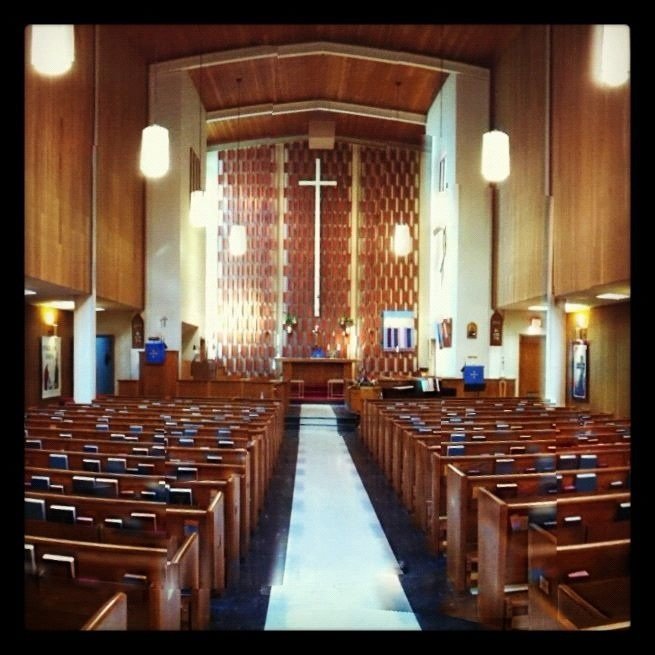
imageWhat is your understanding of sacred space? Is it merely a spot conducive to relaxation and rest? Is the sacredness of a space dependent upon how much you enjoy your time there? Is there any difference between the sacredness found in cabin get-a-ways and golf-course greens, and that which is to fundamentally define the church?
Our life with God has become so individualized in contemporary society that I wonder if we downplay the understanding that church is the house of God. Truth be told, when talking about sacred space, does ‘church’ even enter our minds? A common quip today is “I don’t need to go to the church to be with God, I can worship God equally on the golf course, or the ski hill, or the summer cottage, or the coffee shop.” True. God is everywhere. We see this reality testified to again and again in scripture. Yet scripture also maintains that there is something special about the sacred space of the temple – or later on – the gathered collection of worshipers known as ‘the church’. The temple was seen as God’s house, the localized tent in which God’s presence would reside in magnificent glory. Even though God was everywhere, the psalmists would cry out ‘I was glad when they said, let us go to the house of The Lord’ (Psalm 122:1) or “How lovely is your dwelling place, O Lord Almighty’ (Psalm 84:1). Of course, the internal longing to be in the courts of The Lord was not based merely on the beauty of the building, or the majesty of its adornments. For those in the Old Testament and the New, to be in the temple was to be in the very presence of God, and to be surrounded by the wonderment of God’s divine activity.  God’s presence, localized in the context of the temple,  something incredibly special and unique, not to be duplicated or copied in other places within the world.
Is that the way we see the church today? Do we understand the church as sacred space, a space defined by God’s presence and activity? As we travel along the road and approach our buildings, do we believe, anticipate, andexpect that we will be in the presence of God?
Sadly, it is far too easy to see the church only in human terms. Church becomes nothing more than the place we come to sing religious songs, to hear scripture read, to touch base with friends. (Personally speaking, it is far too easy for me to see church as simply the place that I work. It is the building that houses my office). But if we understand the nature of the church only through the lens of what we do, we completely miss out on its blessed sacredness. If this is the case, then the adage is entirely correct: it does not matter if one goes to church for these religious actions can be done with the same effectiveness wherever one chooses to be.  In this way, sacredness simply becomes a function of where we are, not where God is. This obviously has disastrous effects on the how we view the church, and the God we worship. As Graham Standish writes in his book ‘Becoming a Blessed church’, God merely becomes ‘a theological principle we speculate about rather than a spiritual presence we encounter and experience.’
What is the church if it is not a place where we meet the very one who created, redeemed, and sustains us. Just as Moses was instructed before the burning bush to remove his sandals, as the place he stood was holy ground, so too, we should be overwhelmed by the presence of God active in and throughout the life of our churches.  We should enter through the doors of the church with our hearts leaping with anticipation over what God will do in our midst.
Why did the psalmists write so lovingly of the temple? Why did the disciples spend their time in the temple immediately following the resurrection? Why did Paul, Barnabas, Philip, and others, labour so hard to set up locations in which people would gather together in worship, if these places were not to be understood as spaces where we are invited to encounter the miraculous and powerful presence of our Lord.
Have you ever had the opportunity to sit alone in a church. If not, find a time to do just that. Schedule a time when the sanctuary is empty, and simply sit. Don’t pray specifically, although if your time turns into prayer that is alright. Just sit in God’s place and open yourself to the reality that you are in God’s presence in a special, unique, and blessed way. Open yourself to the Spirit’s movement within you, and around you. You don’t have to stay long, but try to let God define your time there.
After all, that is what sacred space is about isn’t it? Sacred space isn’t about us defining what we like to do, or how we like to interact with God. Sacred space is about submitting ourselves to the movement of God, and allowing God to take the lead in God’s own house.

Saturday, 15 August 2015

Week #21: Celebrate!

The kingdom of God is filled with celebration.  We see this in the prophets, and later in John, as they peer into the heavens.  Endless worship and shouts of 'Hallelujah, 'Glory be to God' and 'Worthy to be praised' fills the lungs of all heaven's inhabitants. Jesus himself took up this imagery. He continually spoke of himself as the 'bridegroom.'  He imaged the Kingdom of God as a party and invited all to enter into such divine celebration.  For Jesus, and for all who take up his invitation, kingdom life is filled with exuberance and joy.  It's a wedding feast, an elaborate gala, a relentless rejoicing.

If scripture is filled with such descriptions of what life in God's kingdom is like, from where did we draw the conclusion that life with God is a bore?  When did we assume that focusing our life on immersion in God's kingdom meant sequestering ourselves from all pleasures and earthily enjoyments.

Yet so often, this is the very thought we have.  We see this particularly when talk turns to the dynamics of Christian discipline, or spiritual practices. After all, how could fasting be enjoyable?  Doesn't cultivating a life of prayer involve one's refusal to enjoy everyday life in order to lock one's self indoors and commit to endless navel-gazing?   Where is the fun in all of that?

Of course, when we add on the controversies, the back-biting, and the insults that sadly run alongside the christian community, we can see why some would conclude that God has nothing to do with fun, joy, or happiness.

Of course, as we saw above, this is not the case.  The kingdom of God is a party, and eternal celebration of the grandest scale.  The actives of faith, even the  more disciplined ones, only serve to usher us deeper into divine joy and abundant life.  As Richard Foster often explains, if the disciplines do not lead you into joy, you have missed the point.

We simply cannot expect to live our lives with any kingdom-focus if we deny the joyous experiences that God leads us into.  If we are too busy trying to live the christian life that we forget to enjoy the christian life, then we have failed to truly take up Christ's invitation.  The fruit of the Spirit involve love and joy, not just self control.  God's presence is intimately found in those times where we laugh and sing.

What is more, the invitation to join God in God's party is to be lived out in our lives.  We don't celebrate by ourselves.  We engage others.  We invite others.  We join others.  The community of faith is a community of kingdom-focused, Jesus loving, party-goers!

Where can you celebrate?  What can you celebrate?  Perhaps you should put down your prayer journal, or your disciplined fasting, and your times of service, and find a party? What would happen if you saw the enjoyable things in life, as ordinary as it might be, as a place in which a kingdom celebration could erupt?  What if you gathered people together for no other purpose that to enjoy each other's company in the Spirit ofGod.

That is kingdom focus.  That is simplicity.  It is the willingness to see our lives lived in God's kingdom.  And that has as much to do with our smiles and parties as it does our serious spiritual works.  So look a celebration and join God's party.

Saturday, 1 August 2015

Week #20: Check email/social Media only twice a day.

A few summers ago I attended Provincial Synod in a neighbouring province.  Unbeknownst to me at the time, the location of the synod was not conducive to my cell service.  The carrier that I use did not have stations in that area.  Thus, my phone was completely useless for the 6 days that I was away.  I was unprepared for the panic that I ensued.  Internally, I felt as if I was entirely alone and powerless.  I felt as if my life would crumble around me and that I could do nothing to stop it.  What would I do, how would I function if I couldn't update my status, send snarky tweets, or check my office email?

We are bound to our electronic devices with emotional chains that we often don't realize.  Most studies agree that the average person checks his or her phone every 6 minutes.  If you do the math you learn that we can't even go one percent of the day without reaching for our phone! We are consumed with the idea that we will miss something important if we don't have our eyes constantly on that screen.

We like to tell ourselves that this is out of a desire for connection.  We want to be available to all people at all times, we say. Of course, the truth is that this isn't about availability at all.  It is about control.  It is about fear.  We have this fear that if we do not have control over our surroundings, then everything will fall apart.  What will people do without our input or our statuses?  Surely life cannot run without these things?  So we tell ourselves that everything is of utmost importance.  Everything is an emergency. Everything demands our time, our response, our input. Why else would we check our work emails while on vacation?  Why else do we refuse to turn off the device? We are simply enslaved to the notion that anything important will be mediated through beeps and chirps, and unless we are there to receive it, to manage it, then something will be thrown off balance.

Of course, in this striving to see ourselves available to all, we actually keep ourselves unavailable. We fill our moments always looking to something else. We wait for the next beep.  The newest notification. The latest post is never as interesting as the one to come.  Life is spent in anticipating what will come next, rather than what is present now.

It can be hard to put down our phones - especially if we have trained ourselves to feel uncomfortable without it in our hands.  Yet when we do so, we are able to uncover the Kingdom of God which is present.  We enter into life in the Spirit as defined by the presence of God here. In refusing to look at our social media devices, we remind ourselves that the world around us runs to a bigger agenda.  We put down the desire to control, to be the one who knows, who answers, and we sit with the reality that God is able to run the things of heaven and earth according to God's good purpose, and not our own.  We remind ourselves that in pursuit of the Kingdom of God,  we are not called to be the ones who lead, but the ones who follow. After all, we cannot be open to Jesus and his kingdom, in the sacrament of the this present moment, if we are too busy waiting for the newest gossip and the latest notification.

There are times which we need to check our email.  And Facebook today is a constant source of communication.  But will anything really be lost if you do not turn on your screen for a few hours?  Do you really need to respond to every email, every tweet, every message the moment in which it comes.  Or can you take some time, to breath, to pray, to seek God's wisdom and guidance in the life in which you are called?  Can you stop long enough to remember that the Kingdom to which you belong is held in His hands, not in your own.

Through the discipline of putting down your phone, you don't lose your beeps and notifications.  In fact, I'm willing to bet that you wouldn't actually miss anything.  What you gain, however, is freedom, and joy, and life in the Holy Spirit.

Friday, 31 July 2015

Week #19: Practice Submission of Will.

In his book, The Making of an Ordinary Saint, Nathan Foster writes about a time where he decided to submit to his children.  For one whole day he allowed his children to define the games that were played, the food that was eaten, that parks that were visited.  Foster engaged in this experiment in order to lean the discipline of letting go, of laying down his 'oppressive desire to have [his] own way' (pg.32).  Foster writes:

" Jesus knew that as humans, we are by nature slaves - slaves to power, slaves to approval, slaves  to escapism.  So instead of leaving us bound to our selfish  desires, he calls us to chain ourselves to his rule of love.  Freedom through submission. " (pg. 33)

We often like to say 'Let God and Let God', yet this phrase is most often spoken of in times where we are pushed beyond our own competencies and prowess.  Submitting to God's will becomes the last resort.   Let go and let God, but only after you have tried everything in your own toolbox!  It is as if we are arguing that God will only step into our lives after we have been drained of all our power and effort.

And in fact, that is exactly what we are arguing.  'God helps those who help themselves' we say.  It's sounds good, but it is a lie that has seeped deeply into the contemporary religious ethos.  It subtlety suggests that faithfulness exists in following our own wishes and whims.  If God only helps those who helps themselves, then we are saying that God expects us to be leaders, controllers, and managers of His kingdom.  Divine help is only found in the context of getting our own way.

This, then, becomes the beginning of the 'heath and wealth' gospel that is so prevalent in the affluent west.  This undoubtedly breeds competition, because if God's power is understood as us 'getting our way',  then every interaction with another becomes a battle for divine favour.  Life becomes you vs. me, us vs. the, winners vs. losers. The  thought of submitting ourselves to God, then, begins to take on association oppression or weakness, or the wilfully allowance of someone to exercise dominance over us therefore abdicating our chance at divine favour and power.  We end up training ourselves to see the life of faith about nothing more than the fulfillment of our selfish and self-focused desires.  It keeps our eye on ourselves as that which is most important.

Submitting to the kingdom of God, and the Lordship of Jesus is not to be a last resort after we exhausted all possibilities. Neither is it about claiming a blessing in that which we have created by ourselves, or muscled through by our own effort.  We lay down the desire to get our own way - not because our way is necessarily bad or wrong but because it always pales in comparison to the plans of God for us.  God spoke to Jeremiah that words 'I know the plans I have for you'; those plans became the framework for Jeremiah's life and ministry.  In submission we remind ourselves that we are, ultimately, not in control.  We are not Saviour, or redeemer, or creator, or the one on whose shoulders rests all the things of heaven and earth.  In submission we take our eyes off of the self and reverently place them on Christ our Lord.

The decision to lay down the desire to push through our own will, voice, or plan becomes a place where we live this out.  It may be uncomfortable, but it ultimately becomes formative as it expresses the deep heartfelt prayer 'Thy kingdom Come.'  We lay down our kingdom in order to be found in his.  This doesn't mean that we are called to submit our will or desire in every and all situations. There is no 'door-mat theology' at work here.  Remember, submission is not about weakness or powerlessness. Ultimately it is about strength in the Spirit of God.  It is when we see a dominating spirit of competition being to rise within ourselves that we wilfully, gladly, and humbly lay down our will not to another - although practically speaking someone else may 'get their way' - but to the Spirit that is present with us.  Instead of ourselves, we focus ourselves in following where we feel the Spirit lead. There is incredible freedom in this.

Ultimately, we cannot seek first the kingdom of God and yet remain locked in the 'oppressive desire to get my way.'  We must lay ourselves down in totality, without reserve.

Tuesday, 28 July 2015

Week #18: Spend time in Spiritual Friendship

We sometimes mistakenly assume that the discipline of simplicity is an entirely solitary discipline.  We see it as something pertaining only to our selves, relating to how we inwardly focus our lives on an ever deepening emersion in the Kingdom of God.  There is truth to this.  Simplicity is about living amidst the Kingdom of God.  We focus on the presence of Christ and we strive to live our lives in step with His Spirit.  Yet it is also true that our lives are lived in the midst of a myriad of relationships.

Simplicity does not call us to isolated caves.  It does not require us to cut ourselves off from those with whom we have established relationships.  Cultivating a single hearted focus upon God involves seeing the friendships that we have in light of God's presence and the call of the Kingdom

This should not be surprising if we consider that our Lord relational in nature.  The incarnation of God was an incarnation into social relationships.  Jesus never stood aloof or removed, but entered into the deepest elements of humanity.  Jesus himself expressed his mission was one of friendship.  "No greater love has anyone than this, that they lay down their life for his friends."  He further describes those who focus on his presence and will in their lives as his friends. (John 15:13-15) More profoundly still, even in the shadow of the cross, at the very moment of betrayal, Jesus still referred to the one who rejected him as 'friend.' (Matthew 26:50)

Because friendship is central to life with God our friendships therefore become central to our life in God. Aelred of Rievaulx, a twelfth-century abbot, wrote a book called 'Spiritual Friendship', in which he observed that 'I am convinced that true friendship cannot exist among those who live without Christ.'  This is because, as James Houston puts it in his book The Transforming Friendship' that the Gospel calls us to 'show self-giving love to everyone' (pg.205).  True, authentic, self-giving love, indispensable to friendship can only be rightly understood in light of Christ's sacrifice for us.

Is it possible to see friendship as its own spiritual discipline? Instead of observing our spiritual disciplines by ourselves, alone in our inner chambers, what if we involved our friends?  Of course, a little introspection is in order.  Who would consider your deepest and closest friends?  Is there a spiritual component in your friendship?  Do you ever share your faith or your spiritual experiences with your friends - or is your spiritual life completely and utterly privatized?

Houston remarks that friendship has been undervalued in contemporary religiosity (219).  We simply do not see our friendships and constituting the tapestry in which we live out the Kingdom of God.  Because of this, the decision to involve our friends into our life of faith can seem daunting and scary.  We are afraid that we will come across as spiritual zealots or that our faith will become a wedge between the previously held relationship.  Yet true friendship must embrace the deepest things of the soul, unreservedly.  It is both in the risk of full self-disclosure and the grace found in acceptance where the Kingdom of God is lived out in our friendships.

This week is filled with plenty of time to touch base with your friends.  Find a time to connect.  Go for coffee.  Go for a beer, or glass of wine.  Go golfing, or bowling, or simply sit and watch tv together. What matters more than what you 'do' is the spirit in which you engage with your friends.  Move deeper in your relationship by sharing the deep things of your spirit.  Share your faith, your prayers, and your spiritual experiences. Offer to pray for your friend; ask them to pray for you.

There is a big difference between social companions, casual acquaintances, and rich and satisfying spiritual friendship that is rooted in the presence of God.   It is this friendship that Jesus himself modelled, and that we are called into.

Monday, 27 July 2015

Week #17: Take your 'off' time.

I like to pretend that I am good at honouring my day off.  I have tried to be diligent in my refusal to answer work emails, along with an overall reluctance to make my way to the church in order to ‘pick something up’.  I even use the language of ‘taking my Sabbath.’  This may sound great, even spiritual, but the secret is anything but.  The fact is, the way I avoid drifting into work demands on my day off is simply to jam my day full of other activity.  I structure the hours of my day so that every minute is taken up.  After dropping my son off at school I attempt to plan my day in away where I will be able to maximize all the things I want to ‘do’ during the short few hours I have to myself.  Sure this may involve a walk down to my nearest coffee shop for coffee, yet this occurs after the planned activities of clearing up the dishes, spending 40 minutes reading; watching a movie and fixing some lunch.  I then go for coffee all the while knowing that if the walk takes me 30 minutes, I can then spend an hour at coffee before needing to walk back to the house so that there is just enough time for me to get into my car, do some shopping, and then get home by 4:00.  Frankly, I find my day off rather exhausting, and it sounds as if it is exhausting for my friend and for any who recognize the same trends in their own lives.  Isn’t the operative word supposed to be ‘off’?

If simplicity is about turning our attention to God then this must effectively change the way we approach our downtimes.  It is easy for us to think that we need to jam our days with a long list of frenetic activity.  We hear, echoing in our ears, the adage ‘idle hands are the devil’s playthings.’  Thus, we do all that we can to avoid such idleness turning our day 'off' into a day of busyness.
Yet in this where is the rest?  Where is the sense of peace?  Where is the sense of being ‘off’ from the frantic running around that is part of the normal routine of life.  What is more, where is the sense of re-creation essential to not only our physical lives, but our spiritual lives as well?  It is like when people express the need for a vacation in order to recoup from their time on vacation.  Clearly the point of time off was missed.

This type of frenetic running around on our time off is not only exhausting, but it drives us to the place of distraction.  We are never able to keep our mind or heart in a focused state because we are too busy looking continually to the next activity.  Again, this is not only physically taxing, but it is spiritually draining as well.  How can there be any peace and rest in the presence of God if we are filled with other things?  In this place of constant movement,  bringing with it ever shifting attentions, how can we ever quiet ourselves enough to delight in the presence and love of God?  Instead, we are left like Jacob who cries ‘Surely the Lord is in this place, but I was not aware of it’ or like Martha for whom it is said is distracted by many things.

There is a deep spiritual problem at hand when endless line of distractions that jam up so much of the work week filters into our days of leisure as well.  The problem isn’t necessarily in what we are doing, as if to say we should not watch movies or drink coffee on our day’s off.   Nor is this simply a lining the day with prayer, bible reading, and other spiritual activities; we would be doing the same thing, yet this time adding on the sense of guilt over not being able to keep focused in prayer or bible reading for the pre-determined length of time.  How can there be any communion with God in this?

The problem lies in the fact that like our regular work week, we define our down-times by what we choose to ‘do.'  Instead of seeing our time off as a time spent with God, in re-creation and and spiritual nourishment, we see it as a time to catch up on our 'to do lists'.

In order to enter into the place of rest and re-creation, we must uncover the glory found in the three letter word ‘off.’  It is here where we release ourselves the perennial pressure to perform or accomplish.  We put down the demands that we sometimes place on ourselves, and are thus able to enter into the day in complete anticipation of God’s presence and activity.  In his book “Streams of Living Water”, Richard Foster uses the phrase 'Waste time for God.'

What would happen if we ripped up those day off to-do lists, and decided to simply waste our time with The Lord.  Is this not what Jesus meant when he said 'Come away with me to a quiet place and get some rest'?  What if we decided to wake up to a day of no demands, no tasks, and no pre-conceived notions of what needs to be ‘done.’  What if the activities of the day were not defined by what we wanted to accomplish, but what the Spirit prompts us to in the moment?  It may just be that it is as we actively turn things off, put things down, and stop our frenetic activities that we find ourselves catching a deeper deep vision of God's kingdom and finding ourselves re-created in his image and likeness.

Friday, 24 July 2015

Week #16: Observe a ast

Surrendering ourselves to Jesus becomes little more than a thought exercise unless we see practical avenues in our lives in which we are given the opportunity to live it out.  The discipline of fasting is one such powerful tool in this regard.  Fasting is the act of abstaining from elements pertaining to our appetite in order to further give ourselves to prayer and communion with God.  It should be noted that 'appetite' does not simply refer to the grumbles of the stomach, but refer to the wants and whims of our human nature.  Fasting addresses those appetites, pertaining to life in the flesh, which only serve to move us away from spirit-filled living and imprison us in a life of self-satisfying cravings.   Through the act of self-limiting, we turn ourselves away from these hindrances in order to more faithfully and intentionally rest in the presence of God.  The physical act of going without that which we crave becomes an echo of the willful and spiritual laying down of ourselves before God.  We ignore the claims of self, with its juvenile cries for attention, in order to more deeply immerse ourselves in the presence of the Spirit.

While we can fast from anything, electronics, media, sex, we most often think of fasting as it relates to our physical appetite for food.  Fasting from food can be a powerful exercise, precisely because much our interaction with food is solely pleasure-based.  That is to say that rather than food being a source of sustenance and nutrition, it is often that which serves to 'make us feel good.' We run to food when upset; we pacify our frustrations with alcoholic beverages, eating has even become a past-time all in itself.   Based solely upon the ever-expanding waistbands of the average North American, it is abundantly clear that we have an unhealthy association with food.

Yet our unhealthy association with food goes far beyond our associations what and how much we choose to eat.  A culture that can turn dieting into a competition clearly illustrates a lack of control over appetites.  Clearly we have lost the basic understanding that food is a gift from God to be cherished and not squandered.

Fasting breaks us out of our self-destructive habits. It shocks the system out of that which in which it has grown comfortable, and in doing so places us profoundly before the spirit of God in uncluttered sacrifice. It is only when we refrain from the gluttonous associations surrounding food that we fully hear Christ's words that "Man does not live by bread alone.' (Matthew 4:4)   By stripping away the amount of time we spend in shopping, ordering, preparing, and consuming food, we open ourselves to receive the better, and more satisfying bread from heaven.

It is important to remember that the purpose of fasting is not simply to go without food for a certain period of time.  The time spent in usual association with food, not freed through the discipline of fasting, is therefore redirected to prayer and worship.  In the Institutes of Christian Religion, John Calvin reminds us that the purpose of fasting is to free ourselves to become 'more eager and unencumbered for prayer.'

 Through the practice of Fasting we are able to address anything that gets in the way of our spiritual progress toward Christlikeness.  By going without our 'appetite' we become confronted with how much of a hold such things have on our lives.    We realize, for example, just how often we check our social media status, how much time we spend on our cell phones, the quickness for which we turn on the television, or how our bodies physically react to the ceasing of constant sugar or caffeine related stimulants. Undoubtedly this can be an uncomfortable process.

There are many different types of food-related fasts that you can do.  If you have never engaged in a fast before, I would recommend a 24 hour-2 meal fast.  Simply stop eating after dinner time on one day, and do not eat until dinner time the next.  A 2 meal fast isn't that hard on your body, you will feel the effects of hunger, which becomes a reminder for you to seek first God's kingdom.  Beyond this, you can try a 24 hour-3 meal fast; for a 36 hour fast.  Remember to drink lots of liquid (water or fruit juice) and consult your doctor if you fear any medical-related complications or concerns.

Much more could be said about the topic of Fasting, particularly regarding the many practical considerations pertaining to how we go about entering a fast.  There is neither time nor space to speak about such matters here.  I recommend Richard Foster’s chapter on Fasting in ‘Celebration of Discipline’ for any who wish to know more.   I end this section with words from Andrew Murray:

Fasting helps express, deepen, and confirm the resolution that we are ready to sacrifice anything, even ourselves to attain what we seek for the Kingdom of God, and Jesus, who himself fasted and sacrificed, knows to value, accept, and reward with spiritual power the soul that is thus ready to give up everything for him and his kingdom. (From With Christ in the School of Prayer)